HMOs are difficult for the host to digest. Human intestinal enzymes leave most of these glycans intact, so a meaningful fraction reaches the distal small intestine and colon. Once there, HMOs become selective substrates for certain members of the gut microbiota rather than a general fuel source for every organism present. Bifidobacterium has a clear advantage in this environment. Species such as B. longum subsp. infantis carry specialized glycosidases that allow efficient HMO metabolism (1). That enzymatic capacity helps explain the HMO prebiotic effect: HMOs enrich bacteria that are linked with gut homeostasis, microbial balance, and a lower inflammatory tone. This is where the mechanism starts to matter. When bifidobacteria ferment HMOs, they produce short-chain fatty acids, acetate, propionate and butyrate. Colonocytes need butyrate, their main energy source, which keeps the gut lining strong. Acetate and propionate do something different. They help send signals that affect metabolism and immune responses.
SCFAs also tie HMO fermentation to inflammation control. HMO-derived SCFAs can lower intestinal inflammation. Two pathways are involved: histone deacetylase inhibition and G-protein-coupled receptor activation (2). So microbial metabolism links directly to immune and epithelial outcomes. There is also a competitive side to the story. Pathogenic species do not benefit from HMOs in the same targeted way. By feeding commensals and helping them occupy ecological niches, HMOs reduce available space and resources for opportunistic organisms. Competitive exclusion and acidification of the gut environment work together. Organisms like Clostridium difficile and pathogenic E. coli find it harder to grow. The result is not just more Bifidobacterium. The whole gut ecosystem shifts, with better microbial diversity and functional output.
HMOs do more than feed bacteria. They also interact with the intestinal epithelium itself. In cell models, specific HMOs have been shown to increase tight junction proteins, which help seal the space between epithelial cells. A tighter junctional network means lower paracellular permeability and a more controlled barrier surface. This has been observed in small intestinal and colonic epithelial models, which makes the barrier effect relevant beyond infant biology (3).
Two layers seem to be involved. One is direct epithelial signaling. The other comes through the microbiome. When HMO-utilizing bifidobacteria ferment these glycans, SCFA production increases, and butyrate becomes especially important. Butyrate supports epithelial energy metabolism and can further strengthen tight junction assembly.
The practical result is less leakage across the gut lining. In leaky gut models, that means reduced movement of luminal antigens and endotoxins across the epithelial barrier. Human observational data point in the same direction, with lower intestinal permeability markers linked to HMO intake, although controlled adult trials are still limited.
A stronger barrier also changes immune exposure. Fewer luminal antigens reaching lamina propria immune cells means less unnecessary immune activation and lower basal inflammatory signaling. This is why HMO gut microbiome interactions are not only microbial events. They connect bacterial metabolism, epithelial function, and host resilience in one barrier-centered mechanism.
HMOs have a useful trick. They resemble the glycan structures that pathogens normally recognise on epithelial surfaces. For organisms trying to attach to the gut lining, that matters. Adhesion is often the first step toward colonisation, and HMOs can get in the way before host cells become the target.
Think of HMOs as soluble bait. Pathogens bind to these free glycans instead of attaching to epithelial receptors. This decoy receptor activity has been reported across several organisms, including Escherichia coli, Streptococcus pneumoniae, Campylobacter jejuni, and noroviruses (4).
In one study, three HMOs have been shown to reduce E. coli adhesion, while the combination of the three had an additive effect (5). This suggests that structure matters and that the right mixtures can improve decoy activity. Norovirus provides another useful example. 2′-fucosyllactose (2’FL) can interfere with norovirus binding to histo-blood group antigens, giving a plausible mechanism for pathogen-specific protection (6).
This part of HMO biology does not depend heavily on live microbial metabolism. HMOs are not only substrates for selected bacteria. They can also act directly at the mucosal interface, reducing pathogen-host contact before invasion occurs.
Less epithelial invasion means less downstream immune activation. That is why this mechanism fits neatly beside the prebiotic and barrier effects. HMOs help maintain gut homeostasis through both microbiome-dependent and microbiome-independent pathways, which makes their anti-pathogenic role biologically important.
HMOs also interact directly with immune cells. Not everything runs through the microbiome or the epithelial barrier. Cell-based studies show effects on dendritic cells, macrophages, and T-regulatory cells, including changes in maturation, activation state, and regulatory immune balance. Inside the cell, one important target is NF-κB signaling. This pathway sits close to the center of pro-inflammatory cytokine production, so even modest attenuation can matter biologically. HMO exposure has been associated with reduced NF-κB activity in experimental systems, which helps explain downstream changes in inflammatory signaling (2). Lower NF-κB signaling usually means fewer pro-inflammatory cytokines. In cell culture and animal models, HMOs have been linked with reduced IL-6, TNF-α, and related inflammatory mediators. Adult observational data also hint at lower systemic inflammation markers after HMO supplementation, but that evidence is still not definitive. Large randomised clinical trials are still needed before firm adult immune claims can be made.
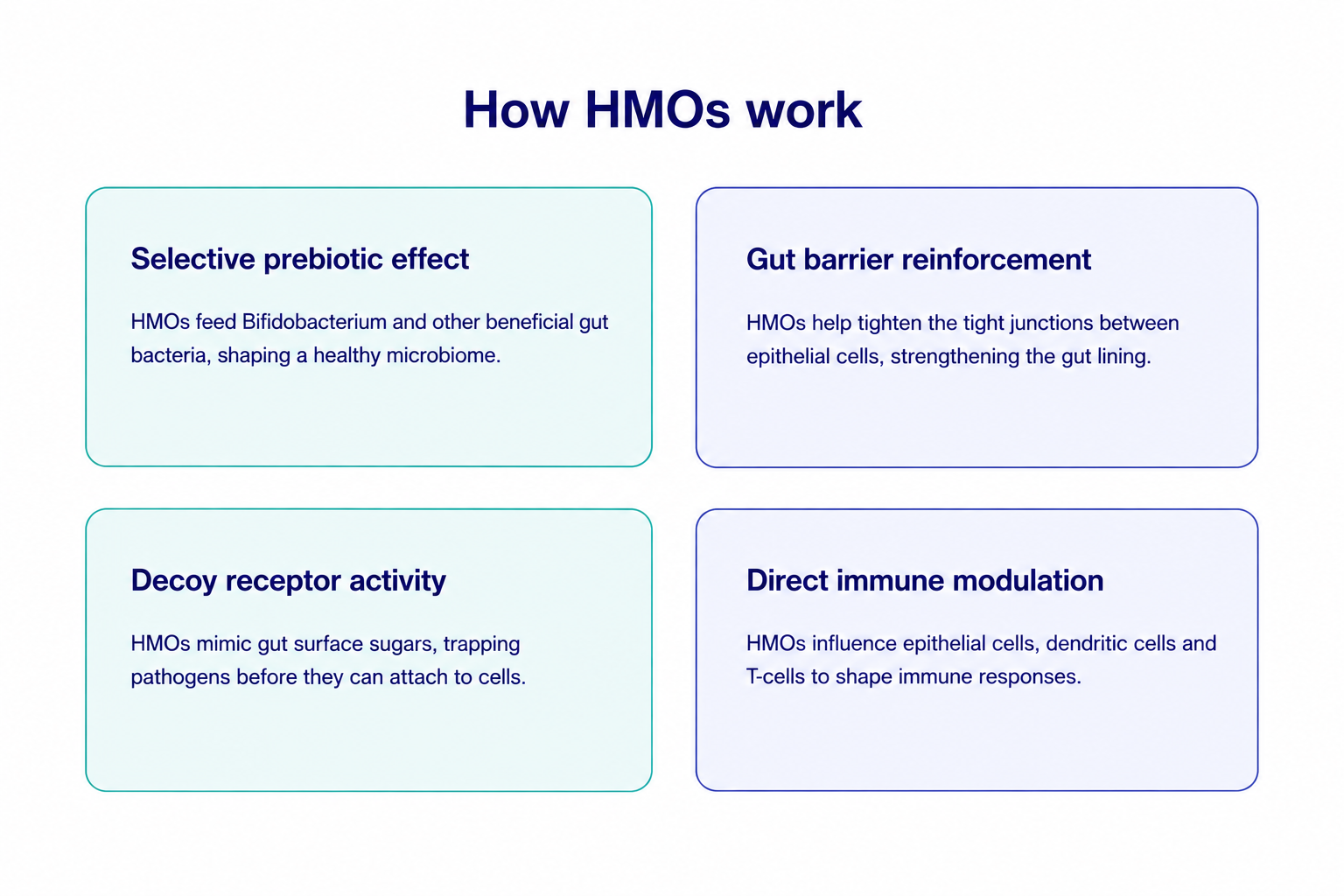
This immune effect fits with the other mechanisms rather than replacing them. SCFA production, barrier integrity, and pathogen exclusion all reduce inflammatory pressure from the gut side. At the same time, HMOs appear to influence immune cell phenotype and signaling more directly. Taken together, the four mechanisms give HMOs their broader relevance. Prebiotic shaping changes the gut microbiome. Fermentation supports SCFA production. Barrier and decoy effects reduce immune triggers. Direct signaling adds another layer to immune function and anti-inflammation pathways. That is why HMOs are increasingly seen as multifunctional bioactives, not just simple prebiotic carbohydrates.
Most human milk oligosaccharides (HMOs) clinical work began in infants, and that is still where the safety and efficacy data are strongest. Adult populations came later, largely because the preclinical biology and gut microbiome findings started to look relevant beyond early life. The adult dataset is thinner, but it is no longer just theoretical. HMO adult supplementation studies now show measurable microbiome modulation, with early signals that may matter for digestive health and immune health. Infant trials still provide the strongest foundation. Adult studies add useful mechanistic insight. The remaining evidence gaps are mostly around long-term outcomes, defined clinical endpoints, and disease-specific populations.
The infant literature is still the anchor point for HMO clinical evidence. Several randomised controlled trials support that position. When 2′-fucosyllactose (2’FL) and lacto-N-neotetraose (LNnT) are added to infant formula, the signal is not limited to stool microbiota. Clinical outcomes shift too. Across these studies, infants receiving HMO-supplemented formula show lower infection incidence and signs of stronger immune resilience (7). Reported differences include reduced antibiotic use, fewer febrile episodes, and fewer respiratory tract infections compared with control formula groups. The biology behind that pattern is credible. HMOs enrich bifidobacteria, and that bifidobacterial enrichment appears to shape intestinal immune responses in ways that reduce inflammatory and infectious pressure.
A European cohort using multi-HMO formulas adds another useful layer. Formulas containing two structurally distinct HMOs were associated with roughly 30% fewer antibiotic prescriptions during the first year of life (7). That is a meaningful clinical signal, especially because antibiotic exposure in infancy can affect microbiome development. Structure diversity probably matters here. More HMO types may support broader microbiome diversity, while also improving pathogen exclusion through different glycan-recognition patterns. That combination makes biological sense: microbiota-driven effects on one side, more direct host-mediated immune benefits on the other. Safety has been reassuring. Tolerability is consistently strong, and growth outcomes look comparable to standard formula. That makes infant HMO supplementation one of the more mature areas in the field.
Adult HMO research is still young. Most work has looked at safety, tolerability, and microbiome modulation, not hard clinical endpoints yet. Elison and colleagues ran one of the key early adult studies with 2’FL. Doses went up to 20 grams per day, over periods of up to four weeks, and the ingredient was reported as safe and well tolerated (8). By week two, the gut microbiota had already moved in a measurable way. Bifidobacterium species increased, and acetate and propionate production also shifted. That is an important signal because it shows the HMO prebiotic effect is not confined to infancy.
Lower-dose work adds another useful piece. In dose-response studies, smaller predicted daily intakes of 2’FL and LNnT still changed the adult gut ecosystem (9). Bifidobacterial populations expanded, and SCFA profiles shifted in a way that suggests real metabolic activity, not just taxonomic noise. So, HMO adult supplementation appears capable of changing microbiome function even at modest levels.
IBS and IBD are more tentative. Some early HMO IBS IBD research points toward better gastrointestinal comfort and reduced low-grade inflammation, but the evidence is thin. Many studies are small, open-label, and built around biomarkers or microbiome endpoints rather than validated clinical endpoints. Placebo-controlled trials in defined adult gastrointestinal populations are still the missing piece.
The adult data looks encouraging, but it is still incomplete. A lot of the clinical data in adults stops at microbiome composition, SCFA production, or immunologic biomarkers. Those are useful signals, but they do not answer the more important question: do HMOs change clinical outcomes in a meaningful way?
Symptom relief is one example. Infection incidence is another. Immune response efficacy also needs direct testing. At the moment, only a small portion of the adult literature measures those endpoints. Many studies show that the gut ecosystem moves after supplementation, but fewer show whether that movement translates into better digestive comfort, reduced inflammatory markers, or stronger pathogen resistance. Long-term safety and efficacy are also not settled. Four to six weeks can show early microbiome effects, but that is not enough to understand sustained HMO adult supplementation. Chronic use, repeated exposure, population differences, and dose-dependent tolerance all need more careful work.
Placebo-controlled randomised trials would help close the gap, especially in adults with defined gastrointestinal conditions or immune conditions. Dosing is another open issue. The field still needs dose optimisation studies, along with trials comparing single structures against multi-HMO combinations. Until those data arrive, the mechanistic case remains stronger than the clinical recommendation base. HMOs are biologically interesting and commercially relevant, but adult nutrition and functional product development still need better endpoint-driven evidence.
Not all HMOs behave the same way. That structural diversity is not a small detail; it changes the functional effects. Some fucosylated HMOs are better known for microbiota shifts and decoy receptors. Some sialylated HMOs draw more attention for anti-viral activity, neurotrophic potential, and gut-brain axis research. Others sit closer to gut barrier integrity and Bifidobacterium growth. For formulation work, that distinction matters. A 2’FL gut health concept is not the same as a broader microbiome modulation strategy built around multiple structures.
A single HMO can make sense when the endpoint is narrow, such as the precision prebiotic effect of 2’FL on gut health, pathogen binding, or a defined anti-adhesion mechanism. Mixtures of HMOs for gut health usually give a wider biological footprint. They can support broader microbiome enrichment, strengthen barrier effects across different intestinal regions, and combine anti-infective with immunomodulatory activity. That is the main argument for multi-HMO formulations in adult supplementation studies and product development.
HMOs are increasingly being investigated as system-level modulators rather than gut-restricted prebiotics. The strongest evidence still concerns microbiome shaping, barrier function, and infant immune outcomes. Applications in cognition, allergy, respiratory health, mobility, and metabolism are biologically plausible but vary in maturity. Most remain emerging, with stronger support from preclinical, mechanistic, and observational work than from adult randomised controlled trials.
The HMO brain health and gut-brain axis hypothesis is supported by growing mechanistic literature. HMOs have been described as modulators of gut microbiota, intestinal barrier function, immunity, and neurocognitive development (10). One idea is that early HMOs change the gut microbiome, and that shift may in turn influence brain development.
HMO cognitive function is an active area of research. Sialylated HMOs such as 3′SL and 6′SL draw particular attention because sialic acid is important for brain growth, but the evidence isn’t limited to these two structures. Fucosylated and neutral HMOs are also being studied for their potential role in neural development, cognition, and brain health.
Animal studies suggest that HMOs may support brain development through gut microbiota, immune signaling, intestinal barrier effects, and gut–brain axis pathways, and observational infant data link different HMO exposure patterns with neurodevelopmental outcomes, pointing to effects that are structure-specific and may involve more than one HMO type (11, 12). The evidence base is strongest on biological plausibility and early-life observational associations, and the natural next step for the field is building out causal clinical evidence: well-designed randomised trials with cognitive endpoints, microbiome profiling, and metabolomic mediation analyses.
The allergy field frames HMOs as potential immune educators. The proposed mechanism involves HMO-driven T-regulatory cell induction, improved epithelial barrier function, and reduced Th2 skewing, which together support the atopy-prevention hypothesis. Reviews describe HMOs as contributors to infant immune competence, with the immune phenotype shaped by HMO structure, host secretor status, microbial ecology, and timing of exposure (13,14).
Supporting evidence currently spans observational and early interventional studies: breastfed-versus-formula cohorts point to lower allergic risk in some settings, a pattern consistent with, though not proof of, an HMO-specific effect, since breastmilk contains many bioactives beyond HMOs.
HMOs may influence respiratory resilience through the gut-lung axis. The working model is microbiome-mediated immune crosstalk: HMOs change gut bacteria, which alters SCFA production and mucosal immune tone, in turn affecting susceptibility to respiratory infections. Infant studies using 2’FL and LNnT have reported lower respiratory morbidity signals, and recent reviews discuss possible protective roles for HMOs in RSV biology (15).
The evidence base here is still building: strongest in infants, drawing on observational, formula-supplementation, and preclinical data, with adult data still sparse. Confirming respiratory resilience as a defined benefit will mean trials that track infection frequency, symptom duration, vaccine response, and relevant immune markers.
HMO effects on joint health are biologically plausible, built on an indirect but coherent chain of biology: changes in the gut microbiome, higher SCFA production, stronger barrier integrity, and a possible reduction in systemic inflammatory tone. That pathway matters because chronic low-grade inflammation is tied to joint discomfort and impaired physical function. If HMOs can reduce inflammatory pressure through the gut, anti-inflammatory effects could carry real value for mobility-focused research. The evidence here already goes beyond a purely hypothesis-generating idea, especially for sialylated HMOs such as 3′SL.
In cell and animal models of osteoarthritis, 3′SL promoted cartilage-protective collagen production while suppressing the enzymes and inflammation that drive cartilage breakdown (16). A related bone-protective mechanism has been reported: 3′SL favoured bone formation over fat-cell formation, blocked bone-resorbing cell activity, and reduced bone loss in an osteoporosis mouse model (17). Most notably, a randomised pilot trial in knee osteoarthritis patients found that oral 3′SL significantly reduced pain and improved physical function versus placebo, with no safety concerns (18). Together, these findings move 3′SL from a mechanistic story toward early clinical signals, though larger trials are still needed to confirm the effect.
HMOs may reach beyond gut ecology and touch metabolism through microbial fermentation biology. The proposed chain is fairly straightforward. HMO-fed microbes increase SCFA production. Those SCFAs then participate in host metabolic signaling, not just local gut effects. GLP-1 is one of the more relevant signals here. Experimental work shows that SCFAs can stimulate GLP-1 secretion in colonic cultures. Human metabolic literature also links circulating SCFAs with GLP-1 concentrations, lipolysis, and measures of insulin sensitivity.
This is why HMOs are gaining attention in weight management, body composition, and metabolic health research. The link is biologically plausible: HMOs can reshape the gut microbiome, and gut-derived metabolites can influence inflammation, endocrine signaling, and metabolic regulation.
The evidence now goes beyond microbiome changes alone. In adults, 2′FL has been studied together with diet and exercise in overweight sedentary participants, with reported benefits for fat loss and body composition markers (19). Sialylated HMOs, including 6′SL and 3′SL, are also being studied in metabolic and functional health contexts. Research on 6′SL has focused on sialic acid availability, muscle function, and clinical outcomes in GNE myopathy (20), while preclinical work on 3′SL and sialic acid connects these compounds with intestinal health and cardiovascular-risk pathways in high-fat-diet models (21).
Overall, HMO metabolic health research is building real momentum, with larger and longer human trials the natural next step to confirm effects on glycemic control, appetite hormones, body composition, liver fat, inflammation, cardiovascular markers, and dose-response outcomes.
Start with the target function the HMO needs to support. That usually makes the structural class choice clearer. Fucosylated HMOs are well studied for microbiome modulation, pathogen decoy activity, and immune signaling, although these effects are not limited to one structure. Neutral non-fucosylated HMOs, such as LNT and LNnT, have documented roles in bifidogenic activity and gut barrier support, but barrier-related effects can also occur across other HMO classes.
For gut–brain axis research, neuroimmune signaling, and antiviral mechanisms, sialylated HMOs such as 3′SL and 6′SL have attracted strong research interest. Even within this class, the strength and specificity of evidence can vary between individual structures. In practice, multi-HMO combinations may cover a broader biological footprint than single-structure choices. Availability matters, but the formulation hypothesis should remain the main driver of structure selection. For broader background, see our complete HMO guide.
Dose is still not fully settled. Adult studies on HMO adult supplementation commonly range somewhere between 1 g/day and 20 g/day, and tolerability has generally looked favorable. Higher doses can move the microbiome in measurable ways. The harder commercial question is smaller and more practical: what is the minimum effective dose for a defined endpoint? Lower intakes may still affect bifidobacterial abundance and metabolite output, but that needs endpoint-specific validation.
Supplier work also needs care. Identity and purity should be checked first. Then come residual carbohydrate profile, moisture, ash, heavy metals, residual solvents, endotoxin levels, microbial limits, and batch-to-batch consistency. Blends need one more layer of documentation: the exact relative abundance of each HMO structure. Stability data also matter, especially for powders, ready-to-drink formats, sachets, capsules, and heat-treated products.
Combinations are where the science becomes more interesting. HMO synbiotics can pair selected HMOs with bifidobacteria or live biotherapeutic products that actually carry the enzymes needed for HMO use. HMO plus probiotic concepts may support targeted colonisation, cross-feeding, and SCFA production. HMO combinations with other bio-active ingredients (such as lactoferrin) are also worth testing because the mechanisms can be complementary. Ingredient stacking alone is not enough. The combination still needs mechanistic validation.
Early screening can save a lot of clinical risk. Several lab tools can help. Dynamic gut models. Batch fermentation platforms. Epithelial co-culture systems. Immune-cell assays. They test different things. Microbiome shifts. SCFA profiles. Gas production. Barrier markers. Pathogen adhesion. Inflammatory signaling. These systems are good for comparisons. Single HMO versus mixtures. HMO-probiotic compatibility. Spotting which microbiomes respond best.
For a deeper look at how HMOs are produced at scale, see our blog about precision fermentation.
HMOs work at several points in the gut at once. They feed selected beneficial microbes, especially Bifidobacterium species, and make pathogen adhesion less efficient. Fermentation also increases short-chain fatty acid production, which supports epithelial barrier integrity and local immune signaling. The strongest evidence sits around microbiome shaping. Barrier and immune effects are biologically credible, but the adult clinical evidence is still developing.
Yes. HMOs are prebiotics, but not in a generic fiber-like way. Human enzymes do not digest them well, so they reach the colon where selected microbes can use them. The effect is structurally selective. Microbes need the right glycosidases and transport systems to metabolize HMOs properly. That is why Bifidobacterium strains adapted to HMO use tend to respond more strongly than many other taxa.
Adult data is growing, especially around microbiome effects. Studies with HMOs such as 2’FL show that adult gut microbiota composition can shift within weeks, with good tolerability reported. That is encouraging. The harder question is whether those microbiome changes translate into outcomes such as digestive comfort, immune resilience, or lower inflammation. Evidence for those clinical outcomes is still less mature than the infant nutrition literature.
2’FL gets most of the attention because it is well studied, widely available, and linked with bifidogenic effects. That does not make it the best choice for every endpoint. LNnT and LNT also matter for Bifidobacterium growth and gut barrier research. Other beneficial microbes prefer sialyllactoses. Functional response depends on structure, dose, formulation format, target population, and baseline microbiome. A single “best” HMO is too simple for this biology.
The immune system gets help from both gut-mediated and direct effects. HMOs shape the gut microbiome, support beneficial metabolites, strengthen barrier function, and reduce pathogen binding. Some data also suggest direct effects on dendritic cells, macrophages, epithelial signaling, and regulatory immune responses. Infant studies provide the strongest clinical immune evidence, especially around infection-related outcomes. Adult immune claims still need stronger randomised trials.
HMOs affect microbiome composition, barrier function, and inflammatory signaling, all of which are relevant to IBS and inflammatory bowel disease. Small studies and mechanistic work suggest possible benefits for gastrointestinal comfort and inflammatory tone. More clinical evidence is needed to strengthen the application cases.
Dosing isn’t one-size-fits-all: adult studies range from well under 1 g/day, where some structures already show measurable microbiome shifts, up to 20 g/day used in tolerability testing, with the appropriate dose depending on HMO structure, endpoint, baseline microbiome, and duration of use. It’s also worth distinguishing “effective dose” from regulatory approved maximum use levels, which are safety ceilings rather than research-optimal doses. In the EU, check the latest EFSA Novel Food register before finalising a formulation, or consult the respective US FDA GRAS notifications.
All commercially-available HMOs, including 2′FL, 3FL, 3′SL, 6′SL, LNT, and LNnT, have been reviewed positively in regulatory safety assessments, with FDA “no questions” outcomes and EFSA safety opinions supporting their use under specified conditions.
Infant and adult studies generally report good tolerability. Mild gastrointestinal symptoms can still occur in some contexts, especially at higher intakes or when total HMO exposure from several sources is combined. For that reason, safety should still be considered in relation to dose, population, ingredient purity, product format, and duration of use.
Adult studies show microbiome shifts can appear in about two weeks. Bifidobacterium levels often change, and fermentation patterns shift too. But not everyone responds the same way. Baseline microbial composition matters.
Brain health is an emerging HMO research area, mainly linked to the gut–brain axis. Sialylated HMOs such as 3′SL and 6′SL get strong attention because sialic acid supports neural development, but they are not the only relevant HMOs. Other structures, including 2′FL and mixed HMOs, are also being studied for neurodevelopment and cognition. Animal and observational infant data are promising, but direct human causal evidence remains limited.
While Inbiose strives to ensure the accuracy and timeliness of the information presented in this document, the company makes no guarantees or assurances regarding the precision, reliability, or completeness of the content. This information is intended solely for scientific and technical purposes in business-to-business communications. Local regulations and requirements should be reviewed when considering product labeling or advertising to end consumers. The information provided does not constitute medical or scientific advice, diagnosis, or treatment, and is offered without any warranties, express or implied. Inbiose shall not be held liable for any damages resulting from the use or interpretation of the material presented herein. The reader assumes full responsibility for their use of the information. No liability is accepted for any infringement of patents resulting from the use of the information provided. Content may be updated without prior notice. For further information, please contact your local Inbiose representative. All trademarks mentioned are owned by or licensed to Inbiose unless otherwise noted.