
Human milk oligosaccharides (HMOs) are complex carbohydrates found in high amounts in human milk. They make up the third-largest solid fraction after lactose and lipids. Levels are highest in colostrum, over 15 g/L, and then drop to about 10 g/L in mature milk (1). But the interesting part is that HMOs are non-digestible for the infant and are not there as calories. They help shape the gut microbiota, assist in tuning immunity, and act as decoy receptors that can reduce pathogen adhesion. That is why they behave very differently from simpler prebiotics.
The structural diversity comes from five basic sugars: glucose, galactose, N-acetylglucosamine, fucose, and sialic acid. These are built onto a lactose core through enzymatic glycosyltransfer reactions. So you end up with linear or branched chains that differ by linkage type, branching pattern, the structure length, and the groups added at the ends. Actually, even a small change in position or linkage can create a different HMO glycan. That is how human milk ends up with more than 200 structurally identified HMOs.
A structural classification tree diagram would help visualise the relationship between fucosylated, sialylated, and neutral non-fucosylated HMOs, showing how each category branches into specific structures like 2’FL, LNnT, and 3’SL. This is not just an academic detail. Small differences in HMO structure decide which good bacteria they feed, how they affect immune signals, and whether they block pathogens.
Fucosylated HMOs often carry α1–2 or α1–3 linkages. Examples include 2’-fucosyllactose (2’FL) and 3-fucosyllactose (3-FL). These are especially important for helping Bifidobacterium species establish in the infant gut (2). Sialylated HMOs carry sialic acid, which is an important building block of brain function (3). They might play a role in brain development. 3’SL and 6’SL are common examples. Neutral non-fucosylated HMOs like LNT and LNnT feed some Bifidobacteria and help the gut barrier stay strong (4).
HMOs are not just nutrients for the gut microbiome. They also act as signaling molecules. Some HMO glycan motifs bind to lectin receptors on epithelial and immune cells (5). That can shift cytokine profiles and affect inflammation. Research also shows that HMO composition is not fixed. It can vary, even within the same person. Those shifts may influence microbiome development and infection risk. So the structure really matters, especially when HMOs are being studied or used in commercial formulation. Without that precision, it is hard to design functional ingredients that reflect the protective and developmental roles of natural human milk.
Human milk oligosaccharides can be grouped into three main HMO structure types: fucosylated, sialylated, and neutral non-fucosylated HMOs.
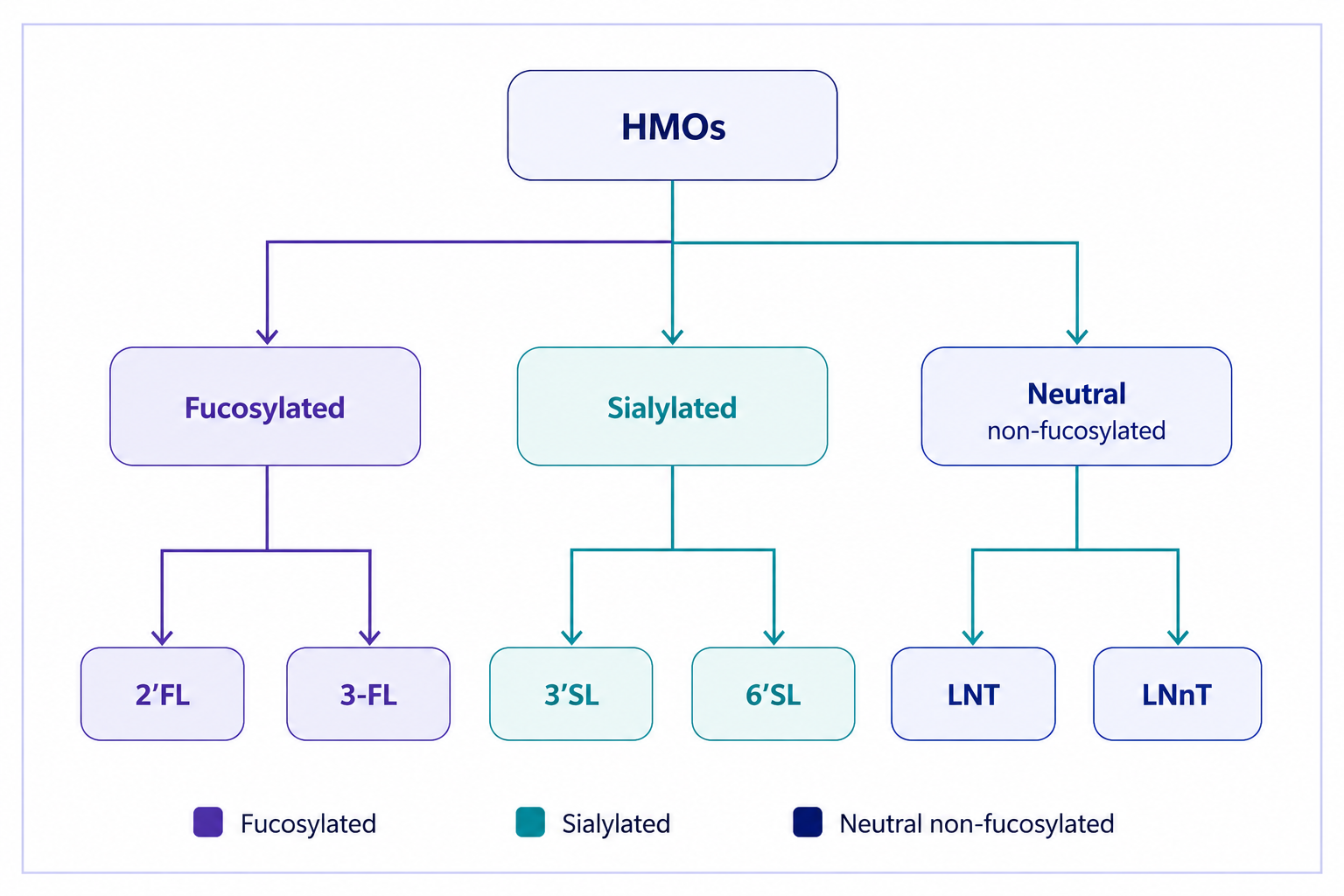
Fucosylated HMOs carry one or more fucose residues, usually at the ends. Examples are 2’FL and 3-FL. These structures help Bifidobacterium grow in the gut. They can also act as decoys to stop pathogens from sticking. And they may influence immune responses too.
Sialylated HMOs have sialic acid at their ends. Common examples are 3’SL and 6’SL. Sialic acid may play a role in brain development and lowers inflammation, while also affecting solubility in water. That matters when formulating infant formula or adult supplements.
Neutral non-fucosylated HMOs, like LNT and LNnT, do not have fucose or sialic acid. Gut bacteria use them to grow. Bifidobacterium especially. They also bring more variety to the microbial mix. Think of them also as scaffolds to extend into more complex HMOs.
HMO composition changes from person to person, and one factor behind this variation is the mother’s secretor status. This status is linked to the FUT2 gene. Secretor mothers have an active FUT2 gene and produce the enzyme α1–2 fucosyltransferase, which is associated with higher levels of α1–2 fucosylated HMOs such as 2’FL (6). Non-secretor mothers do not have functional FUT2 activity, so these specific HMOs are usually much lower or absent.
This difference does not mean that HMOs such as 2’FL are only relevant for one maternal phenotype. It simply shows that human milk naturally varies across individuals and populations. That is why secretor status is often considered in HMO research, especially when studying milk composition, infant gut microbiota, and Bifidobacterium growth.
Other HMOs, including LNnT, LNT, 3-FL, 3’SL, and 6’SL, can also differ between mothers. Together, these variations help explain why human milk has such a wide range of HMO profiles. In this context, secretor status is mainly a way to understand natural HMO variability, not a way to limit the relevance of any single HMO to one group.
HMOs are structurally complex. That same complexity has historically limited their availability at commercial scale. Over the years, several production routes have been explored. Each has distinct advantages and limitations. Researchers, formulators, and developers working on infant formula, adult nutrition, or clinical applications need to know how HMOs are made. Here is how the main production routes compare.
The earliest approach to HMO production was direct extraction from human milk. Technically, it works. But in practice, it comes with major limits. Human milk is a finite source, and HMO levels are relatively low. Colostrum can contain over 15 g/L, with lower concentrations in mature milk. That is nowhere near enough for large-scale infant formula manufacturing. Extraction from human milk also comes with ethical and operational issues. Donor compensation, collection logistics, storage conditions, and contamination risks all need careful oversight. Regulatory agencies require strict screening and safety checks before any material can be used commercially. So while extraction from human milk still has its uses, it is mostly limited to research‑grade material and small‑scale clinical studies. Industrial production? That is not realistic.
Among the different HMO production methods, chemical synthesis gives researchers the highest level of control over glycan linkages and stereochemistry. But it is also one of the most technically difficult routes. Complex HMOs often require long multi-step pathways, sometimes involving more than 20 individual reactions to achieve the right fucosylation or sialylation pattern. Look at the workflow closely and the challenge becomes obvious. Chemical synthesis depends heavily on protecting group strategies and stereocontrolled glycosylation to build the correct branching and linkage structure. That precision is important, but it also pushes costs up very quickly and makes scaling difficult. So chemical synthesis still plays an important role, especially when researchers need highly defined molecules for mechanistic studies. Small quantities of compounds such as 2-fucosyllactose (2’FL) can be produced reliably this way. But for commercial-scale production, especially for complex HMO mixtures, chemical synthesis is still not economically practical.
Enzymatic synthesis uses glycosyltransferases to attach monosaccharides onto a lactose core. The process is cleaner than traditional chemical routes. It also needs fewer reaction steps. That matters when targeting specific HMOs. Especially fucosylated and sialylated structures like 2’FL and 3’SL. The selectivity is much better. You get tighter control over the final structure. But there is a catch. Enzyme cost is still a major issue. So are substrate availability and cofactor regeneration. Those limits become obvious during scale-up. At production scale, the process can become highly sensitive to small changes in reaction conditions. Reaction conditions must stay tightly controlled. The concentration and stability of the enzymes and substrates matter. Small shifts can affect yield. So where does that leave us? Enzymatic synthesis scales better than chemical synthesis. But producing HMOs at volumes needed for global demand is still difficult.
Microbial fermentation has become the main focus for large-scale HMO production. Most systems use engineered microbes with Escherichia coli being the primary workhorse, or one of the few alternatives (e.g. Saccharomyces cerevisiae and Corynebacterium glutamicum). The idea is fairly direct. Specific glycosyltransferases are introduced into the microbe, while lactose acts as the core substrate. That setup allows production of many different HMOs at kilogram to multi-ton scales. What matters is industrial compatibility. Fermentation-based HMO production fits well into existing manufacturing systems. Specialised production facilities already have bioreactors, downstream purification processes, and quality control infrastructure in place. But the biology is not simple. Metabolic fluxes must stay balanced. Byproduct formation has to be controlled carefully. Glycosyltransfer efficiency also affects productivity and consistency. Purification adds another layer of difficulty. HMOs can look structurally similar, especially in mixed production systems. Microbial metabolites also need to be removed cleanly before the final product is ready.
Cell-free or in vitro HMO production uses purified enzymes or enzyme cocktails to build HMOs outside living cells. Everything happens in a controlled reaction system. No microbes involved. That changes the process quite a bit. You avoid cellular metabolism byproducts and get tighter control over the final HMO structure. But the process is still difficult to scale. Enzyme costs remain very high. Industrial-scale reactions are also hard to maintain efficiently. So commercial production is still limited. Right now, most work stays research-focused.
Production method | Scalability | Key limitations |
Human milk extraction | Very low | Supply constraints, ethics, regulatory complexity |
Chemical synthesis | Low | Multi-step synthesis, cost, stereocontrol |
Enzymatic synthesis | Moderate | Enzyme cost, substrate availability, cofactor regeneration |
Microbial fermentation | High | Strain engineering complexity, purification challenges |
Cell-free HMO production | Experimental | High enzyme cost, limited industrial scale |
So at this stage, microbial fermentation remains the main production method for supplying both research-grade and commercial HMOs. Much of that progress comes from ongoing work in metabolic engineering, precision fermentation and downstream process optimisation.
coli fermentation is now central to large-scale HMO production. But the biology behind it is not simple. HMO assembly begins with the lactose core. From there, glycosyltransferases add monosaccharides one at a time, using activated sugar donors such as GDP-fucose, CMP-sialic acid, UDP-N-acetylglucosamine, and UDP-galactose. This allows engineered E. coli strains to produce fucosylated, sialylated, or neutral HMOs, depending on the pathway introduced.
Production efficiency does not only depend on the enzymes. What happens inside the E. coli cell matters just as much. Activated sugar substrates must remain available at the right levels during fermentation, so strain design becomes critical. Teams work on transcription unit design, plasmid copy-number optimisation, and insertion of biosynthetic pathways into the host genome. The goal is stable expression and higher HMO yields over long fermentation runs.
Over longer fermentation runs, engineered E. coli strains do not always perform in the same way from start to finish. Byproducts can build up, substrates may be pulled into competing pathways, and some metabolites can put stress on the cells. When that happens, cell growth is hampered and HMO output can drop. Metabolic engineering is used to reduce these bottlenecks and keep more of the cell’s activity directed toward the target HMO.
Yield also depends on how the fermentation is run. pH, temperature, oxygen supply, and feeding strategy have to be kept within the right range, because they influence both cell growth and HMO formation. For this reason, fed-batch fermentation is commonly used in commercial HMO production. With a well-designed E. coli strain and pathway, selected HMO structures can be produced at industrial scale.
See our blog for a full breakdown of precision fermentation.
So after fermentation, HMOs still need heavy cleanup for food and infant applications.
First step. Removing microbial biomass, endotoxins and other large molecules using micro- and/or ultrafiltration. That clears the fermentation broth before purification starts. The cell-free fermentate is then typically concentrated using nanofiltration prior to being passed through ion exchange columns and over active carbon. This removes small molecules (e.g. acid and salts) and other low-molecular-weight impurities from the process stream.
After that, final processing begins. Potential remaining microbial contaminants are then removed via sterile filtration. Crystallisation or spray drying produces stable powders.
Structural quality matters at every stage. Analytical verification is extremely important throughout production. HPLC, LC-MS and NMR are standard tools across most HMO production workflows. What happens is continuous monitoring of mono- and oligosaccharide composition, and possible contamination before release.
HMO production using precision fermentation can get complicated quickly. Process optimization becomes a constant balancing act. Yield, purity, and cost all pull in different directions. Fermentation optimisation and downstream process engineering matters just as much as upstream strain development, combined with detailed analytical verification throughout manufacturing. That helps maintain batch-to-batch consistency and confirms that the HMO production process meets regulatory and quality standards for infant nutrition and related applications.
Human milk oligosaccharides (HMOs) are now used far beyond human milk research. Interest keeps growing across several industries. Infant nutrition remains the largest area. But adult supplementation, functional food and beverages, medical nutrition, animal feeds, and even plant microbiome modulation are gaining attention as well.
The thing is, HMOs are being studied for several different reasons. Their prebiotic properties matter. So does their immune support and microbiome-targeting potential. Different applications focus on different biological effects.
What matters is context. Not every HMO behaves the same way in every formulation or use case. That is why researchers, formulators, and product developers spend so much time evaluating specific HMO functions across different systems and populations.
Infant formula leads the way for HMO supplementation. Research over the last several years keeps pointing in the same direction. Adding selected HMOs helps infant formula move closer to the biological effects associated with human milk.
Take 2’-fucosyllactose (2’FL) as an example. It is closely linked with gut barrier integrity and also functions as a decoy receptor against pathogen adhesion (7). In addition, 2’FL helps support a bifidobacteria-rich microbiota, while LNnT is linked with broader prebiotic effects.
Clinical trials confirm this repeatedly. Formula containing HMOs such as 2’FL shows growth, tolerability, and immune function that is more comparable to breastfed infants than formulas without HMOs (8). The results are clear across several studies. Infants receiving HMO supplementation often show lower inflammatory markers, fewer respiratory infections, and a gut microbiota profile that looks closer to breastfed infants.
So what is changing now? Multiple HMOs together. The industry is moving toward multi-HMO formulas instead of single ingredients alone. While 2’FL is entering the recipe of common infant formula brands, multi-HMO blends are already available in various premium segments. These combinations include fucosylated, sialylated, and neutral structures to better reflect the structural diversity found in human milk.
Why the shift? Better biological coverage. Broader microbiota modulation. Stronger pathogen defense. Possible benefits for neurodevelopment outcomes too.
The HMO infant formula market continues to grow. Two factors drive that expansion. First, more clinical validation. Second, stronger demand for formulas that match human milk more closely.
HMO adult health applications are growing quickly, especially in the supplement market. Interest now goes far beyond pediatric nutrition. Most HMO adult health applications focus on gut microbiota modulation and immune support. Some products use prebiotic powders alone. Others combine HMOs with probiotics to support bifidobacteria and related beneficial microbes.
Take gut health first. Several clinical trials in adults show positive changes in gastrointestinal comfort and microbial diversity with HMO supplementation (9). Some studies also observe changes in immune response patterns. Interest in irritable bowel syndrome (IBS) and inflammatory bowel disease (IBD) is increasing steadily. Current data points toward symptom reduction and microbiome stabilisation across some patient groups. However, more research is needed.
The results are getting more attention for another reason too. Some HMOs may support infection resilience and help lower inflammation markers under specific conditions.
Here is what makes HMOs different from conventional prebiotics (FOS, GOS). The fermentation profile is usually more selective. That means less bloating and less discomfort in some individuals. Lactose-derived HMOs such as 2’FL and LNnT are commonly used in these products because of their bifidogenic effects and anti-inflammatory effects.
For a full mechanism breakdown, see our blog about HMOs for gut health.
So what does the market look like now? Strong clinical interest. Growing consumer awareness. Multi-HMO formulations are also expanding, especially as companies look for broader functional effects across adult gut health applications.
Medical nutrition is becoming an important area for HMOs. Interest is especially strong for vulnerable populations and hospital-based nutrition support. Take preterm neonatal care as an example. HMO supplementation helps support gut colonisation in early life. NEC is a real risk there. Especially inside neonatal intensive care units. Several studies associate HMOs with lower rates of necrotising enterocolitis (NEC) in these settings (10). Among individual HMOs, disialyllacto-N-tetraose, or DSLNT, has received particular attention in NEC research. Studies suggest that DSLNT may be associated with lower NEC risk and could help guide future preventive or therapeutic strategies, although clinical application still requires further validation (11).
Chemotherapy changes things too. Oncology researchers are now studying HMO prebiotics during treatment periods. The goal is improving gut health during chemotherapy, while reducing gastrointestinal side effects and supporting beneficial microbiota recovery. Still early, but promising research. Current studies suggest HMOs may work alongside standard approaches used in medical nutrition. Research interest in microbiome modulation and immune support in clinical settings continues to increase.
Animals benefit from HMOs as well. Interest in veterinary and animal nutrition keeps growing. Especially in young animals. The science is surprisingly similar to what is seen in human infants. Take piglets and calves as examples. Supplementation supports beneficial microbial growth in both species. Better digestion is another reported effect. Some studies also connect HMOs with stronger pathogen defense and improved growth performance. Researchers are paying attention to the overlap between neonatal animals and human infants. Gut microbiota development shows many similarities. Immunity does too. The field is still developing. But interest keeps growing around HMO products for reducing antibiotic reliance during early-life care. That translational potential between human and animal health is a major reason why companies continue investing in this area.
Plants are different. But interesting. Research around HMO-like glycans and agriculture is starting to grow. Think about the rhizosphere microbiomes. Certain oligosaccharides change how microbes settle near root systems. Sometimes that means more beneficial bacteria. Root systems react to those shifts. So nutrient uptake changes. Disease resistance shifts too. Soil microbiome resilience also gets affected. Root systems matter more than people realise. Small microbial shifts in the rhizosphere can affect overall soil health and crop protection outcomes quite significantly.
Researchers are now exploring HMO-derived and HMO-inspired products for plant growth applications. Interest is especially high under stress conditions where microbial balance becomes more important. Some groups are also studying whether these glycans could reduce dependence on chemical fertilisers and pesticides over time. Sustainable agriculture is becoming a major part of that discussion.
Glycan-mediated interaction studies often rely on HMOs. Defined structures keep experimental conditions consistent across systems. Take a typical glycan array experiment. Different HMO structures go into the same test. Researchers then measure pathogen binding, lectin specificity, and microbial adherence from one platform. Multiple organisms can be compared at once. The same applies to different receptor systems. Many in vitro gut models also include 2’FL, LNnT or other HMOs. Most studies using these HMOs focus on microbiome dynamics and selective bifidogenic enrichment under controlled conditions.
Microbiology labs use HMOs for another reason as well. Species-specific fermentation studies depend heavily on defined glycans for consistent interpretation between experiments. Carbohydrate utilisation pathways also become easier to analyse across different microbial strains when substrate structures remain tightly defined.
Structural diversity matters here. So does reproducibility. HMOs fit well into gut simulation models because they help recreate key selective pressures linked to human milk and the microbiome. The value of this research goes beyond one area. Findings support infant formula development, adult product research, and a broader understanding of prebiotic-microbiome interactions.
The human milk oligosaccharides market has grown substantially over the last decade. Two main factors drive that growth. Scientific validation and scalable production methods.
In 2023, the global HMO market was valued at roughly USD 264 million. Projections put it above USD 732 million by 2030. That is a compound annual growth rate (CAGR) of nearly 14% (Grand View Research, 2023). Infant formula still leads the way. Adult nutrition and clinical applications are gaining ground too.
North America and Europe remain the largest markets. Both have established infant formula industries. Both have clear regulatory frameworks. Consumer awareness of microbiome health is also high in these regions.
The Asia-Pacific region is growing fastest. China has approved multiple HMOs for use in infant formula, including 2’FL. Additional approvals are under review. This regulatory progress is catalysing demand across the region. Global suppliers can now expand operations and launch products in one of the world’s largest infant nutrition markets.
Infant formula accounts for more than 90% of current HMO applications. 2’FL is by far the most widely used HMO. Clinical evidence supports both for improved gut microbiota, immune support, and gastrointestinal tolerance in infants. Adult supplements are growing the fastest, with a CAGR around 18%. What do these products target? Gut health. Immune modulation. Prebiotic support. More people care about digestive wellness now. Microbiome research backs that trend.
What is driving market growth? Precision fermentation and enzyme-based production have changed the game. Scalability is better. Structural consistency is higher. Multi-HMO blends are now commercially feasible.
Regulatory harmonisation is helping across several regions. Market entry has become easier in many countries compared with earlier years. Studies keep showing HMO effects on microbiota, immunity, and cognition. Adult gut health interest is also rising. So the market moves beyond infant nutrition.
But challenges still exist.
Cost of goods remains high for most manufacturers. HMO production costs are still above those of conventional prebiotics such as GOS (galacto-oligosaccharides) and FOS (fructo-oligosaccharides). Premium pricing continues to slow adoption in price-sensitive markets. Steadily decreasing prices will eventually allow market penetration in other markets such as functional foods and beverages. Luckily, HMOs are inherently bio-active already at very low concentrations.
The HMO market continues to move forward. Production technology keeps improving year by year. Regulatory clarity is improving too. Demand tied to infant nutrition and adult gut health remains strong. Growth is expected to continue through 2030. HMOs are becoming an important part of the broader functional prebiotic and nutritional ingredient market.
HMOs are a family of complex carbohydrates found in human breast milk. They are composed of five monosaccharide building blocks (glucose, galactose, N-acetylglucosamine, fucose, and sialic acid), with over 200 structurally distinct HMO species identified to date. They are the third most abundant solid component in human milk after lactose and fat.
Despite being largely indigestible by the infant, they serve various critical biological roles. Collectively, they shape a healthy gut microbiome in early life, with broad downstream effects on immunity, metabolism and potentially neurological development.
Researchers have identified more than 200 distinct HMO structures in human milk, though the exact number continues to grow as analytical methods improve. They are broadly grouped into three categories: fucosylated , sialylated and core/neutral HMOs.
Common prebiotics like GOS or FOS are composed of simple, linear sugar chains, while HMOs are structurally more complex. They selectively feed a narrower range of beneficial bacteria, especially Bifidobacteria, whereas GOS and FOS have a broader, less targeted prebiotic effect. Evidence suggests that they can also act as decoys for pathogens, and some might even send signals to the immune system.
Yes, they are nature-identical. All individual commercial HMOs produced via precision fermentation match the exact chemical structure of their HMO counterparts found in breast milk. However, current commercial production covers only a small subset of the enormous HMO complexity found in human milk.
All commercial HMOs are produced through precision fermentation using engineered microbial strains. In addition, some alternative production methods are also being explored such as enzymatic synthesis. Direct extraction from human milk is not practical or ethical at industrial scale.
Yes. Selected HMOs have regulatory approvals for adult nutrition in the US (FDA, GRAS notifications) and EU (GRAS, Novel Food regulation). Country-specific legislation may apply for other geographic regions.
Adult HMO supplements primarily target gut health, microbiome support, digestive comfort and immune support.
HMOs are used in adult dietary and food supplements, medical nutrition, functional food and beverage, sports and lifestyle nutrition, pet nutrition and animal feed. Infant formula remains the largest application, but adult health is growing quickly.
HMO regulatory approval in the EU and US requires evidence of structural identity, purity, safety, stability, and intended use. In the US, HMOs commonly follow the GRAS route (in line with FDA regulations). In the EU, they are assessed by EFSA under Novel Food rules.
Yes. HMOs are being explored in medical nutrition, especially for preterm infants and gut health support. Research interest includes NEC risk reduction, intestinal barrier support, and supportive care during clinical stress.
Milk oligosaccharides (MOs) are found in human milk and in milk of most other mammalian species, including e.g. bovine, goat and dog milk. Each mammal has a distinct milk oligosaccharide profile. However, human milk contains MOs at far higher concentrations and with much greater structural diversity.
While Inbiose strives to ensure the accuracy and timeliness of the information presented in this document, the company makes no guarantees or assurances regarding the precision, reliability, or completeness of the content. This information is intended solely for scientific and technical purposes in business-to-business communications. Local regulations and requirements should be reviewed when considering product labeling or advertising to end consumers. The information provided does not constitute medical or scientific advice, diagnosis, or treatment, and is offered without any warranties, express or implied. Inbiose shall not be held liable for any damages resulting from the use or interpretation of the material presented herein. The reader assumes full responsibility for their use of the information. No liability is accepted for any infringement of patents resulting from the use of the information provided. Content may be updated without prior notice. For further information, please contact your local Inbiose representative. All trademarks mentioned are owned by or licensed to Inbiose unless otherwise noted.